The History of Stokes Bay Sailing Club
Stokes Bay has always been a popular destination for those drawn to the sea. In 1854, the Stokes Bay and Isle of Wight Steam Boat and Telegraph Company began building a pier at the east end of the bay, anticipating a surge in holidaymakers travelling to the Isle of Wight following Queen Victoria’s construction of Osborne House.
Unfortunately, the pier was heavily damaged during World War II and eventually destroyed by the military. Today, at low tide, the remains of the pier are still visible, with only a warning buoy left to mark the spot where this once-grand structure stood. The Stokes Bay Sailing Club was born just before the outbreak of World War II in 1938. On May 9 of that year, a meeting at Gosport Council Chamber convened to establish a club in Stokes Bay for small boat owners, aiming to bring people to the Alverstoke district. The proposal was approved, and the first officers were elected:
- President – The Mayor, Major C.F.O. Graham, OBE, JP.
- Commodore – Admiral G. Layton, CB, DSO.
- Secretary – Mr J.C. Donnelly.
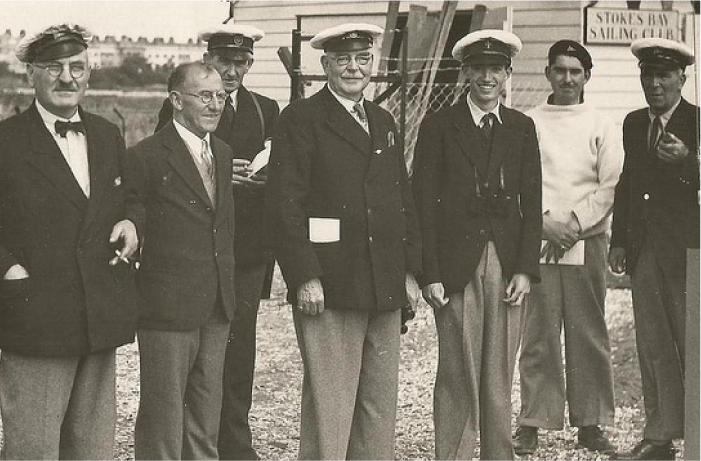
The club’s first regatta took place on August 6, 1938, with the Mayor firing the first guns and breaking the Club’s burgee, which featured the town’s blue and gold colours in vertical sections, with a red horizontal bar at the masthead. For its inaugural season, the club operated from Mr. Rogers’ boathouse near the present Angling Club. By 1939, membership had swelled to 160, and a wooden hut was acquired as the first Clubhouse. However, with the outbreak of war, the club ceased operations in September of that year.
In 1942, an air raid destroyed the club’s records, and the club hut was requisitioned for the war effort. Its exact role remains unknown, but it’s rumoured to have ended up as a shed in a senior officer’s garden. Stokes Bay played a crucial role in preparations for D-Day, being one of the primary sites for the development and testing of the Mulberry Harbours. The grassy field next to the club still bears the remnants of concrete roads, and those who’ve camped during open meetings are familiar with the notorious bent tent pegs!
On August 1, 1946, the club resumed activities, using a two-storey building constructed for D-Day embarkations. Secured temporarily from the Naval Authorities thanks to the efforts of Mr. J. Fairhall and Mr. J. Donnelly, the club’s annual subscriptions were set at 10/6. The first “Pirates Ball” was held in 1948, marking a new era of social events.
In 1950, the club purchased its first rescue boat, “Bystander I”, and its trophy collection grew, with the addition of the “Gussie” trophy in 1952, presented by Mr. C. Gustar. The club also became one of the first to introduce the Langstone system of handicapping that same year. Membership remained steady at around 150, despite an increase in subscriptions to £1. The Firefly National Championships were held in 1954, attracting over 100 entries, and in 1959, the club introduced the Pursuit Race for its 21st anniversary.
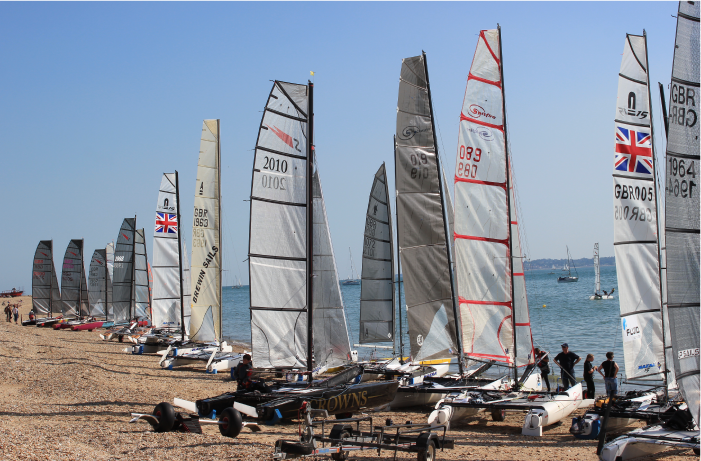
The 1960s were a time of technological leaps and exciting developments. In 1960, catamaran racing began at the club, and in 1965, the first bar was established. The following year saw the installation of electricity and a telephone, and by 1967, showers were added — one for men and one for women. This decade also marked the club’s involvement in popularising sailing nationally, from major sailing events to TV appearances. The Dart catamaran fleet even acted as extras in a Blue Peter episode, where John Noakes learned to sail! In 1969, the club hosted the Optimist World Championships.
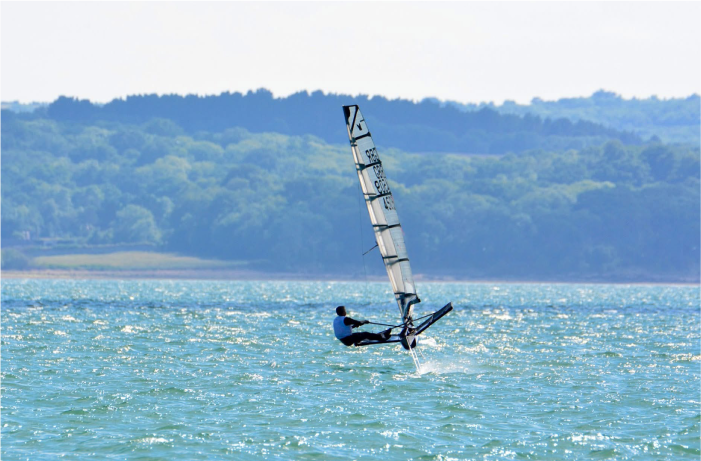
By the 1970s, membership had grown to over 500, prompting the need for an extension to the clubhouse, which was officially opened by Sir Alec Rose. The club continued to host national events, producing its own National Champions during this period. By the end of the decade, windsurfing had arrived at Stokes Bay.
The 1980s were a milestone for the club, with Jason Belben and Andy Hemmings becoming the first World Champions from Stokes Bay. They later represented Great Britain in the 1988 Seoul Olympics. The club also celebrated its 50th Anniversary that year. With membership continuing to rise, the clubhouse underwent a second extension in 1994, which was opened by founder member Mr. J.C. Donnelly.
Video interview with Tony Belben
Past Commodores
|
Commodore |
Year |
|---|---|
|
Carl Downing |
2024 – current |
|
Andy Kelley |
2021 – 2024 |
|
Grace Clark |
2018 – 2021 |
|
Larry Lawrence |
2015 -2018 |
|
Nick Harrison |
2012 – 2015 |
|
Mark Norman |
2009 – 2012 |
|
Philip Beed |
2006 – 2009 |
|
Lou-Lou Fairhall |
2003 – 2006 |
|
Gordon Smith |
2001 – 2003 |
|
Stuart M D Wood |
1998 – 2001 |
|
Mark Norman |
1995 – 1998 |
|
Paul Hutton-Dunton |
1992 – 1995 |
|
Ron Ward |
1989 – 1992 |
|
John Brackenbury |
1987 – 1989 |
|
Alf Spencer Lane |
1984 – 1987 |
|
Alistair Black |
1983 – 1984 |
|
John Lane |
1982 – 1983 |
|
Richard Baker-Jones |
1980 – 1982 |
|
John Donnelly |
1978 – 1980 |
|
Arthur Mathisen |
1975 – 1978 |
|
Cdr Frank C A Ward RN |
1972 – 1975 |
|
Stanley W Tapp |
1969 – 1972 |
|
Dr Reuben G S Skipper |
1966 – 1969 |
|
Sqd Ldr E Lewis Rtd |
1963 – 1966 |
|
John C Donnelly |
1961 – 1963 |
|
Eric J. Downing |
1959 – 1961 |
|
Eric S. Stewart |
1956 – 1959 |
|
John C. Donnelly |
1953 – 1956 |
|
John F Fairhall |
1948 – 1953 |
|
Admiral Sir Francis Austin |
1947 – 1948 |
|
Admiral Sir Geoffrey Layton |
1938 – 1947 |
Honorary Members
|
Sir Ben Ainslie |
Sporting achievement |
|
Mr Jason Belben |
Sporting achievement |
|
Miss Dee Caffari |
Sporting achievement |
|
Mrs Grace Clark |
Services to the Club |
|
Mrs Penny Clark |
Sporting achievement |
|
Mr John Donnelly |
Services to the Club |
|
Mr Chris Draper |
Sporting achievement |
|
Mr Nick Harrison |
Services to the Club |
|
Mr Andrew Hemmings |
Sporting achievement |
|
Mrs Joan Lane |
Services to the Club |
|
Mr Iain Percy |
Sporting achievement |
|
Mrs Rosemary Skipper |
Services to the Club |
|
Mr Alex Thomson |
Sporting achievement |
|
Ms Debbie Wood |
Services to the Club |
|
Mr Ian Bugden |
Services to the Club |
|
Mrs Lorraine Bugden |
Services to the Club |
Membership
As a family friendly and welcoming club that caters to all types of watersports and sailing enthusiasts, we’re happy to bring people onboard!